Showing posts with label historic site. Show all posts

Sunday, September 8, 2013

Biltmore Estate

The Biltmore Mansion

Located just south of Asheville, the Biltmore Estate, at 178,926 square feet (16,622 m2), is the largest privately-owned home in the United States. Built between 1889-1895, the house served as a mountain retreat for the Vanderbilt family, who had earned their money through a shipping and railroad empire. Although the mansion is still owned by the Vanderbilt family, it now mainly serves as a tourist site (and an expensive destination since admission cost $49 if purchased in advanced and $59 is purchased at the door!)

The Italian Garden on the Biltmore Estate

Sadly, photography is not allowed inside the house; however, it is a pleasant little self-guided tour (you would think that for $49 they could at least have tour guides...) Moving through the house, you see a variety of different rooms still decorated in the original style - and several of the rooms have priceless works of art dating from the 1400-1700s.

Walled Garden on the Biltmore Estate

After my time in the house (I only spent about an hour inside the house since I'm not one to stand and look at every single historic item), I walked through the gardens. Surprisingly, I found this to be my favorite part of the Biltmore Estates. The gardens on the Biltmore grounds were designed by Frederick Olmstead, the man who designed Central Park in New York City. Walking through the vast grounds, you almost feel like you are in a gigantic city park. (I guess unlimited wealth allows you to splurge on a team of gardeners.)

Bass Pond on the Biltmore Estate

After my time in the gardens, I walked to the estate's Bass Pond and saw a charming twig bridge and boathouse. On the way back to the mansion, I took the Woodland Trail, which lead me through a very natural forest (I felt as though I was back on a hike in the woods.) When I finally arrived back at the house, I caught the shuttle bus and headed to Antler Hill Village and Winery, which proved to be little more than a small petting zoo and a collection of restaurants. Overall, the Biltmore Estates proved to be an enjoyable destination (though perhaps not worth the $49.)

Sunday, June 2, 2013

Colonial Williamsburg

Governor's Palace at Williamsburg

To complete my colonial weekend in Virginia, I moved eastward to the colonial capital of Williamsburg (and the historical village that has been set up to re-enacted the 1770s.) Although a little expensive ($42), Colonial Williamsburg provided a full-day of entertainment (though there was a bit too much walking in the hot Virginia sun...)

Colonial Garden

Williamsburg proved to be a good mixture of colonial capital, average town, and multitude of actors. The larger structures (the Governor's Palace and the Colonial Capitol) were the main tourist stops, I actually found the smaller shops with the typical workers far more interesting.

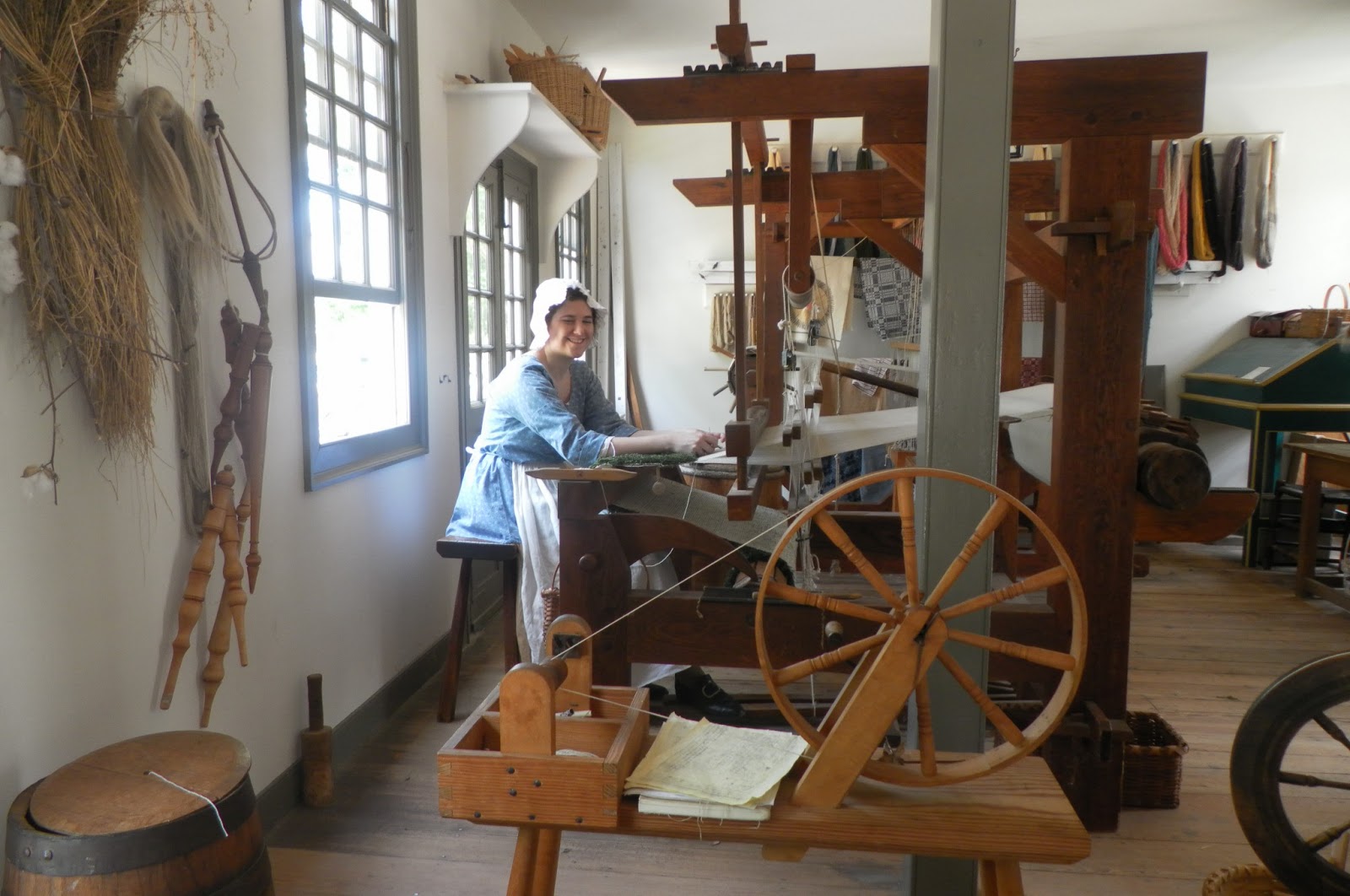
Woman weaving cloth in a traditional manner

The smaller shops included silversmiths, cobblers, weavers, basket-makers, a wig-maker, and many more. At each shop, the actor was working his or her craft while explaining the process and history behind it. Of all the shops, I found the weaver's shop to be the most interesting (though that was perhaps because I had the most knowledge about yarn and the dying process.) I would have purchased some of their hand-spun and hand-dyed yarn, but it was $25/skein!

Benedict Arnold in front of the Capitol Building

In addition to all the wonderful buildings and shopkeepers, there were also a number of historic re-enactments throughout the day. Some were more interesting than the others; however, the highlight was an afternoon production that involved the British storming the capital and placing Benedict Arnold in charge of the city. It was interesting - though Benedict Arnold proved very difficult to photograph since he was overly dramatic in his role. However, it made a good ending to a day in the 1700s.

Saturday, June 1, 2013

Monticello

Monticello reflected in the house's fish pond

This morning, I made the 4-hour drive to Charlottesville in central Virginia. A couple months ago, I had seen a picture similar to the one above, and decided that I really wanted to visit Thomas Jefferson's plantation home, Monticello. After reading a long biography of Jefferson, I finally decided to book the tickets for my brief weekend getaway.

At Monticello, there are two basic ticket types. The standard admission is about $20 and covers the first floor of the home and tours of both the garden and the slave quarters. For $40, however, you can get this - plus a behind the scenes tour of Monticello's upper floors. Since I figured this would likely be my only visit I'd ever make to Monticello, I went ahead a splurged on the more expensive tour.

The West Lawn at Monticello

My "Behind the Scenes" home tour was scheduled for 2:30, so I had plenty of time to explore before my guided tour. I spent some time in the museum, but found it a little lacking. Fortunately, I was able to join the hour-long guided tour on "Slavery at Monticello." Although this tour was fairly educational, I found it a little disappointing. The tour was little more than an educational lecture - there was nothing really to see (just the empty spaces which once contained slave quarters...you would have thought that they could have reconstructed at least one of the cabins.)

Fortunately, the slavery tour did fill most of my time, so I simply walked the grounds taking pictures while I awaited my house tour. When it came time for the house tour, I learned that the "Behind the Scenes" groups are much smaller than the normal groups (which are herded through the house at 15-minuter intervals.) My group of about 15 was first led through the ground floor (which all the tours see and is decorated as it was in Jefferson's day. Eventually, we were led to a very narrow stairwell and continued to the second and third floors.

In the recent past (like six-months ago), these upper floors were used as the museum's offices; in fact, they are currently still in the process of renovating these rooms. Only one of the rooms had actually furnishings, but it was very interesting to see the unfinished rooms (we could see what the flooring under the stoves was like and how the beds looked when not outfitted with bedding.) The highlight of the upstairs tour is the dome room atop the house (the large empty room directly below the front dome.) Overall, it was a very impressive tour (and well worth the extra $20.)

Monticello's vegetable garden

After the house tour, I continued with a tour of the flower and vegetable gardens that surrounded the house. I was actually surprised how many flowers were in bloom (I thought the summer heat would have killed them...) After the garden tour, I made a quick stop at the Jefferson's grave site and continued back to my car. It was a long (hot) day at Monticello, but I definitely enjoyed myself.

Sunday, May 12, 2013

Harmony Hall Plantation

Harmony Hall Plantation

As I was driving to Wilmington last month, I noticed a sign for Harmony Hall Plantation (one of the oldest homes in North Carolina.) Since the plantation is only opened 4 hours/weeks (Saturdays from 12:00 - 2:00, and Sundays from 2:00 - 4:00), I wasn't able to visit the plantation on my way back from Wilmington (fortunately, the plantation is only 25 miles (40 km) from Fayetteville....so it wasn't an impossible drive.

Now, when I hear the word "plantation", I tend to think of Gone with the Wind's Tara or other large antebellum homes. Sadly, Harmony Hall bears no resemblance to these later, more elaborate, homes. Built around 1760, the two-story home is a very simple structure with only two rooms on each floor (and a very scary-looking attic above.)

Dining Area of Harmony Hall

The first floor included a middle hall (which was quite cool thanks to the front and back doors provided a breeze through the house.) On one side, was a simple dining area, which looked very much like a 18th-century colonial room; the other room was a living area, which was obviously furnished with furniture from a much later time period.

Climbing the exterior stairs led to two unremarkable bedrooms. A smaller set of interior stairs let to a small, and very creepy attic-space (which was furnished with nothing but a bed.) The attic was probably a very good representation of a room during the time period, but I don't think you could paid me enough to sleep in that room (it was scary in the middle of the day!)

Kitchen at Harmony Hall

After the tour of the main house, I saw the outlying kitchen and several other historic buildings (which were not original to the site.) Overall, Harmony Hall was a somewhat interesting site - though I wish I could have timed it so that it had been a 20-minute stop on my way to or from Wilmington.

Friday, March 29, 2013

New Bern

Tryon Palace

This morning, I headed east to the town of New Bern - the English capital of colonial North Carolina. Today, the town's main attraction is the reconstructed colonial governor's "palace" from the early 1770s. Located in the historic center of town, along the Trent River, the original Tryon Palace was destroyed by a fire in the late 1790s - and only rebuilt in the 1950s. (Though great lengths were taking to make it as historically accurate as possible.

Tryon Palace (which was named after the colonial governor who built it) had a great tour that gave a realistic view into colonial life in the 1770s. I was especially impressed to see all the traditional garments worn (I never really knew what women wore under their skirts to get them to stick out to the sides (I'm more accustom to seeing the later hoop shirts and petticoats. The house also had an interesting kitchen area, where female volunteers were cooking traditional recipes using colonial techniques.

Gardens of Tryon Palace

Outside Tryon Palace, there are a variety of gardens (which all seemed to be in full bloom!) The grounds included: a traditional French-style hedge garden, a "native" garden (which featured plants from North Carolina), and a kitchen garden with a variety of vegetables. Sadly, the view of the Trent River behind the palace was ruined by a number of ugly concrete bridges...

John Wright Stanly House

In addition to the palace, there was a tour of two other "smaller" houses from the colonial period. The John Wright Stanly House was built during the same period as the palace, and even hosted President Washington when he toured the Southern states. The house was very beautiful, but the thing I found most interesting was the fact that this building served as the town's public library from the 1930s - 1960s. I can't imagine working in a building that was over 200 years old! (Something tells me they wouldn't appreciate 40 preschoolers shaking their sillies out in a historic home...) After the tour of the Stanly House, we also viewed a slightly newer (1810s) Dixon House, which had belonged to one of North Carolina's early congressmen. All in all, it made for a very interesting trip back into the 1700s.